
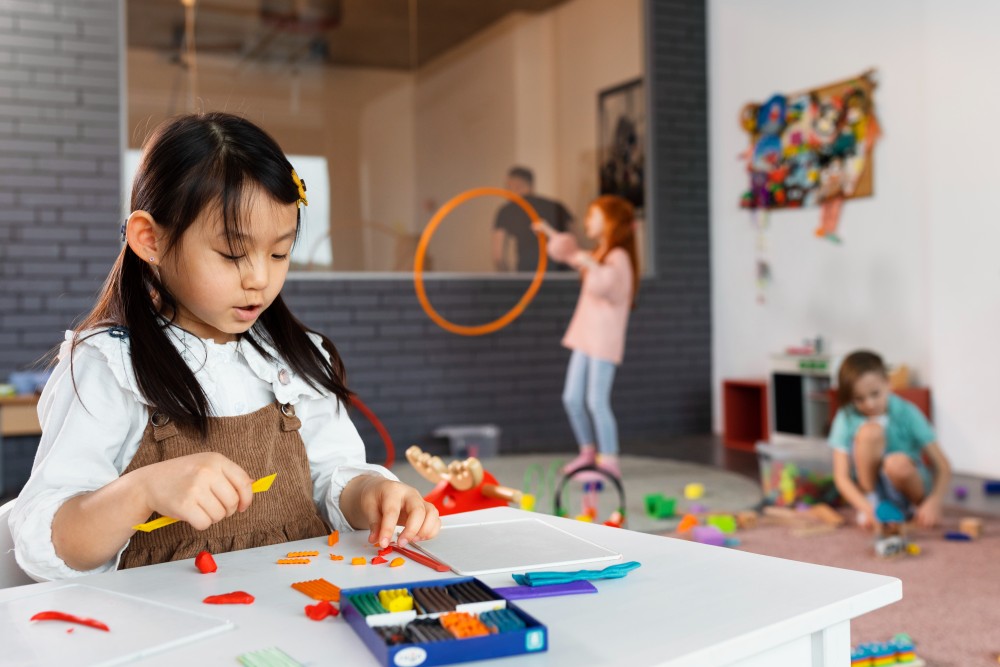
The biggest benefit of Montessori for toddlers and preschoolers is that it helps children become confident, independent, and curious learners from the earliest years. Instead of forcing children to fit into a fixed system, Montessori allows them to explore, make choices, build real-world skills, and develop at their natural pace. This early freedom combined with gentle guidance helps young children grow emotionally, socially, and intellectually in a balanced way.
Why the Early Years Matter More Than We Think
The first year of a child’s life determines the way they view themselves and the way they learn, how they deal with emotions and how they resolve problems. Preschoolers and toddlers are naturally curious, explorers. They play, climb or play, look and imitate, and push boundaries to learn about the world.
Montessori education is based on this natural development, rather than trying to reroute or speed it. Based on decades of observation, child-development research and hands-on learning The Montessori approach creates a place where children are confident instead of feeling overwhelmed and enthralled instead of pushed.
1. Encourages Independence From the Start
One of the most visible strengths of Montessori is that children learn to do things on their own practically and confidently.
Toddlers and preschoolers learn to:
- Pour water
- Dress themselves
- Choose their activities
- Tidy their own materials
- Prepare simple snacks
- Solve small challenges without adult rescue
These everyday tasks may look simple, but they build motor skills, focus, patience, and self-belief. A child who learns “I can do it myself” at age 3 grows into a teenager who feels “I can handle this.”
2. Builds Deep Focus and Concentration
Montessori classrooms are deliberately calm, well-organized and well-planned. This helps toddlers and preschoolers develop focus naturally, something that most traditional settings struggle with.
Children choose an activity that they truly enjoy and continue to work on until they are satisfied. Since learning comes from genuine curiosity, not from pressure, their attention span increases naturally.
A child who can concentrate completely on the number 3 will be able to build a solid base for writing, reading math, and problem-solving later on.
3. Strengthens Real-World Skills Through Practical Life Activities
Montessori doesn’t start with abstract academic drills. It starts with life skills, fine motor, coordination, responsibility, self-care, and care for the environment.
Activities include:
- Washing hands
- Watering plants
- Sweeping
- Buttoning and zipping
- Setting a table
- Caring for pets
These tasks help toddlers and preschoolers develop coordination, confidence, order, and emotional maturity. The goal is not chores—it’s building competence.
4. Encourages Social-Emotional Growth
Montessori classrooms are often mixed-age, which means toddlers learn from slightly older children, and preschoolers learn to guide younger ones. This structure builds natural empathy and cooperation.
Children learn:
- How to wait their turn
- How to solve conflicts calmly
- How to communicate needs
- How to help a friend
- How to be respectful of personal space
Instead of competition, Montessori fosters kindness and teamwork traits that will matter throughout life.
5. Supports Language Development in a Natural Way
Montessori places strong emphasis on spoken language, vocabulary expansion, storytelling, and hands-on literacy activities.
Children are exposed to:
- Real objects and matching cards
- Rich vocabulary in conversations
- Songs, storybooks, and poems
- Letter sounds and phonetic games
This builds a strong foundation for reading and communication without rushing academics.
6. Boosts Early Math Understanding Through Concrete Learning
Young children learn best by touching and moving. Montessori math materials allow toddlers and preschoolers to feel numbers, not just memorize them.
They learn concepts such as:
- Quantity
- Counting
- Patterns
- Shapes
- Sorting
- Simple operations
Because these concepts are built physically with beads, blocks, number rods the understanding is deeper and longer-lasting.
7. Inspires Natural Curiosity and Love for Learning
Montessori follows the child. That means the teacher does not push worksheets or force a child to learn a concept before they are ready. Instead, the child’s curiosity decides the pace.
When children choose learning instead of being forced into it, they develop:
- intrinsic motivation
- confidence
- problem-solving skills
- joy in discovery
This love for learning stays with them long after preschool.
8. Creates a Calm, Respectful, and Safe Environment
Montessori environments are carefully designed with:
- low shelves
- child-sized furniture
- accessible materials
- beautiful, orderly spaces
This reduces overwhelm and overstimulation. Toddlers and preschoolers feel secure when their world is predictable and peaceful. A calm environment helps them regulate emotions, behave better, and feel confident.
9. Builds Motor Skills Through Hands On Exploration
From threading beads to climbing on toddler-safe structures, every Montessori activity strengthens motor development.
Montessori supports:
- fine motor skills (pincer grip, hand control)
- gross motor skills (balance, coordination)
- sensory development (touch, sight, sound)
These skills prepare children for writing, sports, creativity, and daily life activities.
10. Encourages Respect For Self, Others, and the World
Montessori children learn to care for their environment, handle materials gently, and treat others kindly. Respect becomes a daily habit, not a lesson taught once a week.
Toddlers and preschoolers become:
- more mindful
- more patient
- more empathetic
- more aware of their impact
- more responsible
These qualities shape strong character from the early years.
Conclusion
Montessori education provides preschoolers and toddlers with a strong foundation, not just for school, but also for life. It helps them develop into confident, competent and curious well-balanced individuals. Through fostering independence as well as encouraging exploration and respecting the child’s own natural pace Montessori nurtures children who are enthusiastic about learning and feel at ease with who they are.
If you’re looking to have your young years filled with positive development, instead of stress, Montessori is one of the most effective and child-centered methods that are available.